Monday, 5 March 2018

Work Record One: (Uta Barth Inspired)

Work Record One

Plans For shoot:
For this shoot, I will take out of focus images. I will use a Nikon D7200 for with an 18-55 lens, and I will have the camera on manual focus so that I am able to take out of focus images. I'm going to travel to the industrial area of Harlow to take my photographs as they are busy during the day and if the weather permits I will get glare, which my chosen photographer uses.

My inspiration for this shoot is Uta Barth and her familiarly nostalgic photography. She takes out of focus images that distort the shot enough so that we're able to see the outlines of the shapes but we're unable to distinguish the people or the place.  

Image Bank:
Image result for uta barth
Image result for uta barthRelated imageImage result for uta barth

Contact Sheet:

Images that need improvement:
D725896:
When I took this shoot it was bitterly cold and the wind was extremely strong, this meant that the sun was blinding until it moved behind the clouds. I was using a Nikon D7200 with an 18-55mm lens. The settings I was using were the manual focus so that I was able to blur the image deliberately, f/4 so that I would have a shallow depth of field and a higher chance that I would get lens flare circles (below) which are a regular occurrence in Uta Barth's work that I liked. I was using an ISO of 200, which was low enough that it was unlikely that the shots would turn out grainy. The reason the shot was so dark as I was experimenting with the camera settings and as I was changing the exposure I moved it to 1/5000 as it was very bright outside, however, this proved to be too dark for these conditions so I adjusted it while I was there.
Image result for lens flare circle
(example of camera glare)

D725924:
I dislike the framing for this image as the post box takes up too much of the shot. I was trying to mimic Uta Barth's technique where only an arm or a face is in focus in the foreground, however, I had moved too far behind the post box. I was able to change this as I was looking through the shots as I was taking them and adjusted the framing accordingly.

D725945:
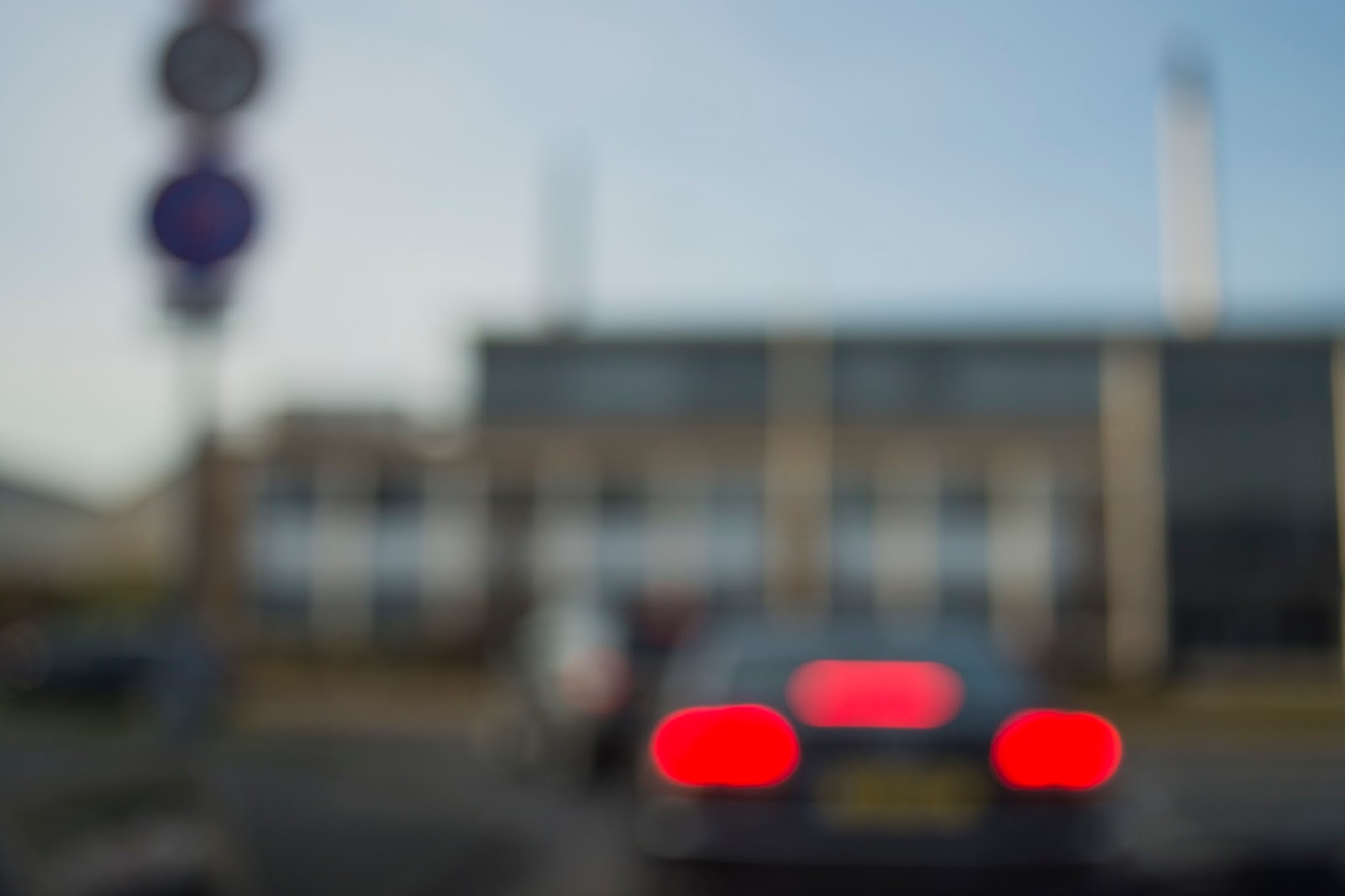
I was in a moving car while I was taking this shot sitting in rolling traffic. I wasn't worried that the shot would turn out blurry as I had the camera on a shutter speed of 1/640. The reason I don't like this shot is the framing again. I wanted to capture the brake lights of the car in front as I liked the blurred effect the lights created, and in this shot I have the camera angled too high and they aren't in the frame. 

My Best Images:


This is the blurred view of the Harlow Industrial Estate behind the Pinnacles, however only I know what the real image looked like. Everyone else has to look at this memory through this fuzzy jumble of shapes and lighting. I like this image because this is how I see memories in my minds eye, they're blurry and out of focus for all those who weren't present. However, for those who were there this blurry image is all that's needed to stir the memory of the bitter East winds that plagued us.  


I specifically like this image over the image before as the framing is different and consequently so is the meaning. In the first image I've captured the building and the lights and if the shot was in focus I would consider it well framed, as it shows a place at a certain period of time, which is the basic nature of photographs and before them paintings. In spite of this, it isn't my favorite shot of the two. This is because it's trying to tell a story of that place at that time which isn't what Uta Barth does, in my opinion.  
She takes photographs of memories as I see them, blurry snapshots that whip the person back into that place at that time and yet still manages to keep the memory personal as the blurred shot is unrecognizable to anyone else but still relays the emotions associated with that environment.

 This is what I feel I have achieved with the second image as it portrays being stuck in traffic, a unique and frustrating situation only experienced by those driving during rush hour or other peak congestion times. I like this image as it's not about the place or the time it was taken, it's about the situation itself and the emotions you go through when being stuck in traffic. For me what I feel when I look at this image is the bottom of your stomach drop beneath you when you realise that you've reached the point when it's no longer rolling traffic and your just sitting there waiting helplessly and indefinitely. 

AO3: Record ideas, observations and insights relevant to intentions, reflecting critically on work and progress.

My favourite images I took on this shoot are the ones of the car in front of us in the traffic. I feel like this image I have recreated the same emotional effect that Uta Barth creates with her images, it is a completely foreign image to everyone and yet you can feel the precise emotions that are associated with traffic: anger, frustration and impatience. Even though only me and my father were there when I took the photograph, I feel everyone can relate to it. 

AO2Explore and select appropriate resources, media, materials, techniques and processes, reviewing and refining ideas as work develops.

I chose an 18-55mm lens, I specifically chose the industrial estate as  the setting as it was bright and busy, which meant I would get good reflections off of the car roofs and I like the layout of the street.
I switched the camera to manual focus and unfocused the camera, this would give me the same effect that Uta Barth has in her images. As I was working I fluctuated the camera settings by lowering or raising the F-stop. By changing the F-stop I was changing the depth, I noticed that when I made the depth of field shorter I captured better camera glare that at a longer F-stop. This experimentation allowed me to find the best F-stop for camera glare and consequently improved the images that followed this discovery.  

AO1: Develop ideas through sustained and focused investigations informed by contextual and other sources, demonstrating analytical and critical understanding.

My initial idea was to simply take photographs of the industrial estate and to shoot while I was there. Despite this, when I got back in the car to go home I didn't put the camera away, instead I sat in the front seat with the camera on my lap. It just so happened that going home we got stuck in traffic, providing the perfect opportunity to take photographs of traffic and the break lights on the back of cars. I chose to do this as it was one of the things Uta Barth did and I wanted to experiment further with her style. 

To improve this shoot I will go and take photographs in her style but following the theme of Juxtaposition. To do this I will take photographs of urban and natural settings in Uta Barth's style to show a comparison of nature and how humans have encroached on nature. 


Computer Experiments:

To improve my images I opened them in photoshop.I shoot in RAW files as I like the freedom it gives me when it comes to adjusting and editing my images.   
  
  I didn't change the temperature of the image as I liked how warm it was. I raised the exposure as I wanted to brighten the image, I also brightened the shadows and lowered the white to ensure the image wasn't too light so that the details can be seen. 
I also lowered the clarity to further distort the image. 

I used the same process for all of the images, only varying slightly from image to image. 


A04:Present a personal and meaningful response that realises intentions and, where appropriate, makes connections between visual and other elements. 


Edited images:


I feel I have responded well to the given theme and evaluated and chosen a theme that best suits my style and my interests in photography. This shoot's strength comes from the research I completed before I shot in Uta Barth's style, and because of this the end result was the one I'd envisioned at the beginning.

For my next shoot I would like to delve deeper into the style of Bokeh and experiment further with the effects that it creates in another shoot.   

Juxtaposition:
To relate this shoot to the theme of juxtaposition I used Uta Barth's style of Bokeh and merged it with the perfect reminder of mortality: the skull. 

Images:
Here is a sample of the images that I'd like to make in my final outcome. I used layers and the background eraser tool to remove the rest of the image and keep the Uta Barth inspired image inside the skull. 

I like this juxtaposition of the light's inside the skull as light is generalised as a symbol for life and skulls symbolise death. 

Thursday, 1 March 2018

Definitions Of Options

Definition:

Foreground and Background:
"Photographers and filmmakers can create drama and impact in their work through careful consideration of the relationship between foreground and background. Berenice Abbott paid careful attention to the spaces in between objects in the frame. Tony-Ray Jones' photographs often recorded activity taking place in the middle distance. In her photographs of interiors, Candida Hofer leads the viewers eye from the foreground to the background."

Foreground definition: The space at the front of a photograph (closest to you). 
Background definition: The space at the back of the image (farthest away). 
If I was to choose this as my theme for the exam I would like to focus 

Here are some examples of foreground and background photography:


Framing Devices:"Many photographers and filmmakers have used doorways, windows, arches and trees as framing devices when composing or structuring their images. Saul Leiter, John Szarkowski and Eugene Atget have made use of various framing devices to explore abstract qualities, to create mood or to suggest stories. "Framing devices definition:A framing device is a shape that surrounds the object of focus in images, thus framing it. Examples of framing devices:
This image is of a fox that is standing stock still and staring at the photographer. Only the fox and the storm flies that are closest to the fox are in focus. This effect is created by using low F-stop, which creates a shallow depth of field.  

Juxtaposition:


"Many photographers have exlored the creative opportunities of juxtaposition to provide comparison and emphasise contrast. Visual elements within phtographs or photographs themselves can be juxtaposed. Uta Barth and Frank Gohlke in his aftermath series, both present photographs in pairs. Henri Cartier-Bresson explored juxtaposition when composing his images."

Juxtaposition Definition:

the fact of two things being seen or placed close together with contrasting effect.


Angles and Grids:
"Photographers and filmmakers sometimes create images in which angles and grids are emphasised. Stephen Shore's observations of road junctions often include diagonals. Andreas Gursky has observed grids in the interiors and exteriors of buildings. Zeke Berman's diptychs use a combination of angles. "

Angles and grids are a means of framing and arranging the image before and after the photographs are taken. Here are some examples of  Angles and Grids in photography:
 

Objects in Spaces:
"Photographers and filmmakers have been inspired by the relationship between objects and the places in which they are found, kept and used. Walker Evans' studies of interiors, the still-life photography of Wright Morris and the tabletop arrangements of Andre Keretsz all depict items in specific locations." 

Objects in spaces is a very simple principle but can carry very powerful messages. Here are some examples of objects in spaces photography:


Research Log

Research Log:


"Generations" by Allen Hughes
This is a photo of vintage cameras and more modern cameras next to each other. I like this photo as it shows photography through time, but also the photograph was taken by a Nikon D300s, furthering the line of camera's development. 


By Nathan Goldenberg 

I like this image as the ice captures light so effectively it looks like it glowing and is a stark contrast against the pitch black of the sandy beach. I love this juxtaposition between light and dark, and between the sea and the shore. The ice is the solidification of the water that has worn the stones smooth that have been scattered across the beach, it's like the water has taken on a life of it's own and crawled from the sea to beat the sand into submission, a constant war between light and dark, the rough ice and the soft sand.
"My son & my dad" by Zeev Roytman
This image is very touching to me as the older hand is weathered and aged and the other hand is smooth and youthful. This shows the generations of a family playing piano. I love the juxtaposition between young and old, the experienced and the novice. 


Daniella Zalcman's: double exposure of London and New York
She has used basic editing software to layer her own photographs of New York and London over each other, juxtaposing one city and one lifestyle over each other. 

"Past and Present" by Francisco Little: Beijing's modern National Theatre stands alongside the old style Soviet architecture of the country's Great Hall of the People.
I like this photograph as it shows how people have developed and the different styles that have resulted in these changes.  


Didier Notlet - Landscape Skulls 
This is an art piece that was painted by Didier Notlet for an art exhibition, they have painted landscapes onto two different skulls. I like this idea as the skulls represent death and the landscapes painted on them represent life; if you pay particular attention to the colour used by the artist you'll see bright yellow and green which are often associated with wildlife and foliage. 


Image result for cheech sanchez photography
Cheech Sanchez -The Hangover Part III
I like this images as the skull is buried by wrappers from junk food. This has several layers of meaning. It could mean that the skull ate too much junk food and consequently died, or it could be meant as a wicked example of irony because the skull is dead and so doesn't need to eat. 


Thursday, 22 February 2018

Illustrated Discussion

Illustrated Discussion:

Foreground and Background:


Berenice Abbott:(17 July,1898-9 December, 1991)
She was an American photographer best known for her portraits of between the wars. In early 1929 she went to New York looking for a publisher but soon saw the city's photographic potential. She returned to Paris and closed her studio before returning to New York. The first photographs she took were on a Kurt-Bentzin camera, producing 8 x 10 inch negatives. Her main focus was framing the subject and the spaces in-between the frame. 


This is the view from one of the skyscrapers in New York at night, I like the way she has shot this image as she has removed herself from the chaos of everyday life and become an observer. 

I like her style as a photographer as she always seems distant from the photographs she has taken. However, her work is centered around New York and I wouldn't be able to commute to a large city for this exam. 


Tony Ray-Jones: (7 June,1941-13 March,1972)
He was an English photographer, he usually recorded activity in the middle distance. 


This photograph has a sick sense of irony. The cow is standing in a restaurant, shortening the distance from the source of food to the consumption of it. 

I like his images as they are very descriptive, it's almost as if you've walked into a small snippet of his life with every shot. On the other hand, I would describe his images as documentary rather than foreground and background as they are very mundane in the way they're shot.   

Candida Hofer:(Born 1944)She is German-based photographer and former student of Hilla and Bernd Becher. Like her mentors she has taken a strictly technical approach to the interiors of similarly-shaped buildings.  Hofer has captured a view of a library. The rows and rows of shelves stretch out into the distance, like the stories and separate universes the books contain.I love how she draws you into the images, it's like she's letting you explore the building for yourself and she's simply giving you a tour. The only drawback is that her photos are limited to long buildings, which aren't in high supply in England.I don't think I will pursue Foreground and Background as for me the images are distant from their subjects, showing only a glimpse of their world that is far more complicated that the shots show, consequently it lacks depth in the direction of the images subjects.   Framing Devices:Saul Leiter:(3 December,1923-26 November,2013)
He was an American Photographer that used windows as a framing device, often the window was foggy, subsequently obscuring the identity of the subject.

You can tell the gender and the basic outline of this man in a suit,suggesting that he's middle classed in the 20 century, all other aspects are a mystery. By removing his identity Leiter is forcing us to form an opinion based on the limited knowledge we are presented. I love how his photos are like a diary of the past in Retro America and I enjoy how his subjects are oblivious, and consequently behaving naturally. His shots would be hard to replicate in modern times as people are always expecting to be watched and so want to more strictly control how they portray themselves to the world, leading to less and less people giving permission for photographs. 
John Szarkowski:(18 December , 1925 – July , 2007)He was an American photographer that focused on the framing of his images, best known for his work on the "Photographer's eye".  

The fact that this derelict building has no roof shows how it has fallen into disrepair, however the beautiful clouds symbolise a sense of hope and positivity.I don't like his style of photography. As photos are subjective to the viewer people will misinterpret or misunderstand photos. In his case I simply don't understand his images, this may have been his initial idea as it made me think of different meanings behind his images.   Eugene Atget: ( February12 1857- August 4 1927)
Eugene Atget was a pioneer in documentary photography, his main focus being the streets and architecture of Paris, before they were consumed by modernisation.

Image result for Eugene Atget

This large feat of architecture was most probably in Atget's home, France, where he documented many buildings. I like the way he has chosen to include the reflection in the water of the building. 

I like Atget's work as he was a rebel against time. He tried desperatiely to document the world he lived in and loved before time stole it from him. His photographs are beautifully meloncholy as we are unable to visit the places he's been, but perhaps some would aregue that that's the purpose of a good photograph: to document something that will vanish beofre your eyes. 


I like this topic as there are many different direction I could take it. However,I will not be using framing devices for my exam topic as most framing devices seem like cliches, and I find them over-used due to everybody's acess to a camera has lead to repetition. 

Juxtaposition: 

Uta Barth: (29 January 1958)
Uta Barth takes atmospheric photographs of streets out of focus to allow the viewer to assume some control over what they're seeing by forcing their imagination to fill in the blanks that the lack of focus creates. 
Image result for Uta Barth:

This image is of  a traffic-light junction in America. The blurriness suggests that the viewer has been in an sccident and is still shell-shocked from the impact. 

I like the very fact that her work is visually challenging, it truly makes you think about her images and their subjects. I might use her in my work as I like the idea of getitng the viewer's imagination to complete the image, and the emotions this process stirs in the viewer. 

Frank Gohlke:  (3 April 1942)
Frank Gohlke uses juxtapositon in his images like a master of the  subject. Most of his images are in black and white which stresses the emotions behind them, which are mainly of a distant sense of nostalgia. 
Image result for Frank Gohlke:

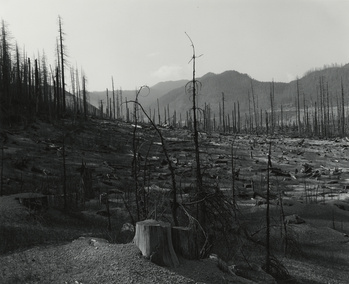
This is a photograph of what remains of a vast wood in America after a forest fire. This image creates a deep sorrow when considered thuroughly. Due to the grand scale of this tradgedy it is inevitable that animals would have died and their homes destroyed. 

I would like to use Frank Gohlke's style in my exam as he uses juxtaposition to inspire emotions in the viewer that could have been overlooked if the shot was taken by another photographer.

Henri Cartier-Bresson:(August 22,1908 -August 3,2004)
Henri Cartier-Bresson was best known for his works toward the decisive moment, capturing shots that vanish within seconds after he took them. His skills were undeniable and he was capable of seeing the world like very few do, and sharing his view world.  
Related image

This is the view of a woman ascending the stairs out of a subway, and the pidgens are flying out of their path. There's a deep symbolism behind this image as nature has to move as human storm through, leaving chaos in their wake. 

Evaluating my options:
I don't think I will be using his style in my work as he uses a lot of black and white photography and different tones in his work that I don't think I 'd be able to replicate. 

I'm considering using juxtaposition for my exam as I like the contrast that the images have and the way this makes the viewer feel. 


Photographer Research One : Uta Barth

Photographer Research


Uta Barth:
Uta Barth is German/American photographer that lives in Los Angeles. She manipulates focus to create soft light effects in her work. I have chosen her as my first photographer as she creates a soft grunge-style of nostalgia which is a form of juxtaposition in itself as most viewers have never been to the places she has photographed and she's made it extremely difficult to find them. This is because she doesn't want the place itself to be the object of focus, but the feeling the light and colours create. I adore this and hope to use this in my work. 


Image result for Uta Barth

1999: Light
Uta Barth has used the lens flare in this image to create a welcoming and bright atmosphere. The first thing I think of when I see this image is waking up late in the afternoon with the sunlight streaming in through an open window, warming the whole room.

Image result for Uta Barth

Frieze
The angle of this image and the reflection of the glasses on the table imply that she is crouched taking this shot, or at a child's height. The reason I believe she has done this is to inspire people's memories of when they were children and would run around their homes in the summer amongst the furniture, after being warned not to run around the house. 


Image result for Uta Barth

Field 23
This is obviously a wall down one side of a street, all other details are obscured. As with most of her work this image reminds me of playing in the streets a child, or walking to and from school. I believe she purposely creates vague images so that the viewer has to create their own memory to place the image somewhere rational,rather than it be an obscure image. 

Image result for Uta Barth

This is a photograph of traffic, taken at a red light (top right corner) somewhere in America, as their junctions are infamous for having overhead traffic lights. The way this image is shot suggests impatience and agitation at being delayed, this is conveyed through the poor framing of the image: we can only make out the large black car,everything else is blurred.


Influence and Summary:

Here's a comparison of Barth's and my own work: 
Left:My own work, Right: Uta Barth's.


Uta Barth influenced my work by making me consider how I'm framing the image rather than simply looking at the subject. I've utilised her work and experimented with her style of photography and found that I enjoy spontaneity but also the emotional and nostalgic side of photography that she captures so well. 
I used manual focus to blur the images but keeping the outlines of the buildings and the cars was important to me as it stops the shot from becoming completely abstract, but rather keeps the scene behind a thin veil that only the photographer can see behind. I changed the F-stop to the lowest it would go (around 4.5) which create more light circles, which was the effect I was hoping for. The ISO was around 200 and the exposure was around 1/500.

Another photographer that uses Bokeh is Jordan Parks. He mainly focuses on objects in the foreground and the light effects Bokeh creates. I would be interested in looking at his work in further detail to see what I can learn from his techniques. 

My Work: